Apparel
 Auto, Home & Tools
 Bags
 Business & Office Products
 Drinkware
 Food & Candy
 Outdoor & Leisure
 Stationery
 Technology
 Toys & Novelties
 Wellness and Safety
 Writing

 Bookmarks
 Booklets
 Brochures
 Business Cards
 Custom Calendars
 Door Hangers
 Envelopes
 Event Tickets
 Flyers
 Greeting Cards
 Hang Tags
 Invitation Cards
 Labels
 Letterheads
 Magnets
 Menus
 NCR Forms
 Postcards
 Presentation Folders
 Rack Cards
 Sales Sheets
 Stickers
 Trading Cards
 Table Tents

 Banners
 Canvas
 Decals
 Event Tents
 Flags
 Posters
 Reflective Signs
 Signs
 Table Covers
 Tension Fabric Displays
 Trade Show Booths



Raised Foil Printing Guide: Gold, Silver and Holographic Foil You Can Feel (and How It Compares)

Most metallic printing is something you see. Raised foil is something you feel. Run a thumb across a raised foil card and the gold, silver or holographic foil rises up to meet it, a small moment that makes a card feel expensive and memorable. This guide explains what raised foil is, how to choose a foil color, why velvet soft touch matters, how raised foil compares with foil stamping and Akuafoil, and how to design and set up files for great results.
Key Takeaways
- Raised foil (also called embossed or 3D foil) stands about 60 microns above the card, so you can feel it.
- PrintMagic offers raised gold, raised silver and true raised holographic foil.
- Every raised foil product uses 16 pt cardstock with 1.5 mil velvet soft touch (suede) lamination on both sides: 19 pt total.
- Foil stamping is flat and mirror-bright; Akuafoil is smooth metallic in any color; raised foil is the one you feel.
- Keep foil to about 30% of the design, foil text at 10 pt+ (12 pt for bold fonts) and lines at 1 pt+.
- It’s an affordable way to look premium, starting at just 100 pieces.
What Is Raised Foil?
Raised foil is foil applied over a raised layer, so it stands up from the printed surface instead of lying flat. It pairs a bright, reflective metallic shine with a tactile 3D texture. Because the height is about 60 microns, it’s subtle to the eye but unmistakable to the touch. Your full-color design prints first, and the foil goes only where your mask file says.
Gold, Silver or Holographic: How to Choose
| Foil | What it says | Pairs well with | Popular with |
|---|---|---|---|
| Raised gold | Established, trusted, luxurious | Black, navy, emerald, burgundy, white | Law, finance, real estate, jewelry, hospitality |
| Raised silver | Modern, precise, cool | Charcoal, slate, navy, black | Architecture, tech, automotive, photography |
| Raised holographic | Bold, creative, almost majestic | Black for drama, white or pastels for a bright, futuristic look | DJs, creators, beauty, fashion, startups |
Not sure? Gold is the safest premium choice, silver is the most understated, and holographic is the one people talk about.
Holographic Foil vs. Holographic-Style Effects
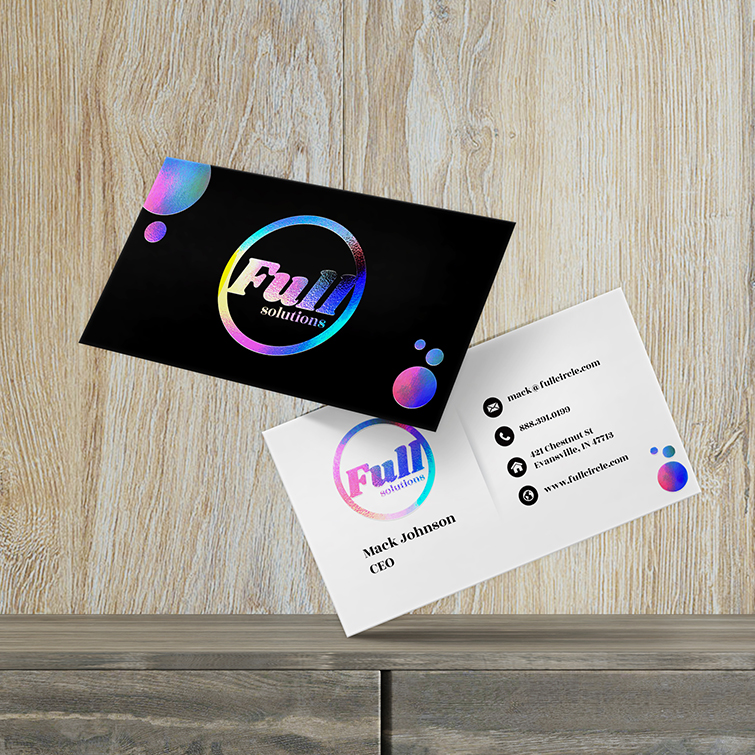
“Holographic” can mean two different things in printing. Raised holographic foil is a true holographic foil: its rainbow colors shift as the card tilts, and it’s raised so you can feel it. A holographic-style effect, like the one Akuafoil creates, is a rainbow gradient printed over a smooth silver foil base, great for colorful designs and collectible cards. If you want the classic color-shifting holo on a business card, postcard or holiday card, choose raised holographic foil.
Why Velvet Soft Touch Matters
Raised foil feels its best against a soft surface. That’s why every raised foil product is laminated on both sides with a 1.5 mil scuff-resistant velvet soft touch laminate (also called suede or soft touch), bringing 16 pt cardstock to a substantial 19 pt. The velvet gives colors a rich, matte depth and a soft, almost fabric-like feel, so the crisp, raised foil stands out even more. It’s a finish in a class of its own, the kind of card people keep.
Raised Foil vs. Foil Stamping vs. Akuafoil
| Raised foil | Foil stamping | Akuafoil | |
|---|---|---|---|
| Texture | Raised about 60 microns: you feel it | Flat, with a slight pressed-in feel | Smooth |
| Look | Bright, reflective metallic with dimension | Solid, mirror-bright, uniform metallic | Metallic in any color, gradients and holo-style effects |
| Colors | Gold, silver, holographic | One solid foil color per stamp | Any CMYK color over a silver base |
| Stock on PrintMagic | 19 pt velvet soft touch (suede) | Varies by product | 16 pt C2S (most products) |
| Choose it when… | You want people to feel your logo | You want a classic, flat gold or silver | You want vibrant, multi-color metallic |
Want even more dimension? Dual Raised combines raised foil with raised Spot UV (a clear gloss layer about 50 microns high), or two raised foils, on one piece. See Dual Raised Business Cards.
Design Rules for Great Raised Foil
- Stay under about 30% foil coverage. Too much foil can look wavy; less looks more luxurious anyway.
- Choose bold type: 10 pt or larger, or 12 pt for bold or thick-stroked fonts, with proper kerning.
- Keep lines at 1 pt or thicker, and skip hairlines and tiny details.
- Nothing under the foil: remove text and CMYK elements beneath foil areas so the foil sits on a solid background.
- Contrast is king: deep card colors make gold and silver glow; white makes holographic bright and modern.
- Leave small details in ink: phone numbers, emails and fine print stay crisp in standard printing.
Common Raised Foil Mistakes
- Foil everywhere: covering most of the card dilutes the effect. Pick a hero element.
- Script fonts and hairlines in foil: fine strokes don’t raise cleanly. Go bolder.
- Raster masks: pixelated edges can be rejected. Use vector masks in 100% K.
- Artwork left under the foil: it can show around the edges. Clear the area in your CMYK file.
Setting Up Raised Foil Files
Send your full-color CMYK artwork plus a vector mask for each side with raised foil (100% K for foil, white for none). Check alignment, clear the CMYK under the foil, and name files by side, such as File-Front-CMYK and File-Front-Mask. Full steps are in our raised foil file setup guide and Raised Foil FAQs, and our designers can create the mask for you.
Is Raised Foil Worth It?
For anything people hold, like business cards, invitations, VIP mailers and holiday cards, raised foil is one of the most affordable ways to look premium. You can start with just 100 pieces, the cost per piece drops as quantities grow, and a card people keep works for you long after the handshake. In a stack of flat, glossy cards, it’s the one that cuts through the clutter.
Raised Foil Ideas by Product
- Raised Foil Business Cards: a raised gold monogram on black for a law or wealth firm, or a raised holographic logo on white for a creator.
- Raised Foil Postcards: “Just Listed” in raised gold over a property photo, or a raised foil gala invitation.
- Folded Raised Foil Greeting Cards: raised gold foil Christmas cards for clients, or holographic holiday cards for a modern brand.
- Velvet without foil: Velvet Soft Touch Business Cards and Velvet Soft Touch Postcards.
Ready to Feel the Difference?
Browse our raised foil printing collection. Need a larger quantity or a custom size? Request a custom quote. Questions? Chat live, contact us or call (888) 391-0199.
Frequently Asked Questions
What is raised foil?
Foil applied over a raised layer so it stands about 60 microns above the card, combining a reflective metallic shine with a tactile 3D texture.
Is raised foil the same as embossed foil?
Yes. Raised foil is often called embossed foil or 3D foil.
What’s the difference between raised foil and foil stamping?
Foil stamping is flat and mirror-bright. Raised foil stands up from the surface so you can feel it.
What’s the difference between raised foil and Akuafoil?
Akuafoil prints full color over a silver foil base for smooth metallic in any color. Raised foil is gold, silver or holographic foil you can feel.
Is raised holographic foil real holographic?
Yes. It’s a true holographic foil that shifts color as it tilts, raised so you can feel it.
Which raised foil color is most popular?
Raised gold, especially gold on black and gold on white.
What is velvet soft touch lamination?
A 1.5 mil scuff-resistant laminate (also called suede or soft touch) on both sides of the card, giving a soft, matte feel and a 19 pt finished thickness.
How much foil can my design have?
About 30% of the artwork or less for the best results.
What’s the minimum font size for raised foil?
10 pt, or 12 pt for bold or thick-stroked fonts.
Is raised foil affordable?
Yes. It’s a premium finish with a low cost per piece, starting at just 100.
 Signs